Why the Barbershop Menu Looks the Same Everywhere but Isn't
You've seen the same services listed at every barbershop: haircut, beard trim, hot towel shave. Maybe a scalp massage. The pricing varies — $25 at one place, $55 at another — but the menu reads identically. Here's what most men miss: those aren't commodity services with arbitrary price differences. They're fundamentally different experiences, and the "extras" aren't upsells designed to pad the bill.
The difference between a $20 chain haircut and a $50 barbershop appointment isn't just time or ambiance. It's what happens to your skin, your hair follicles, and your scalp during those additional services. A hot towel treatment isn't a warm face decoration — it's pre-shave prep that determines whether you walk out with smooth skin or razor burn. Beard conditioning isn't optional pampering for guys with long beards — it's maintenance that prevents the wiry, uncomfortable growth that makes you want to shave the whole thing off.
This article breaks down what each service on a barbershop menu actually does — the mechanical and chemical processes, not the marketing descriptions. By the end, you'll know what to book based on your hair type and skin condition, not just what sounds nice.
The Hot Towel Treatment: What It Does and When You Need It
A hot towel treatment sounds like luxury. It's actually functional prep work.
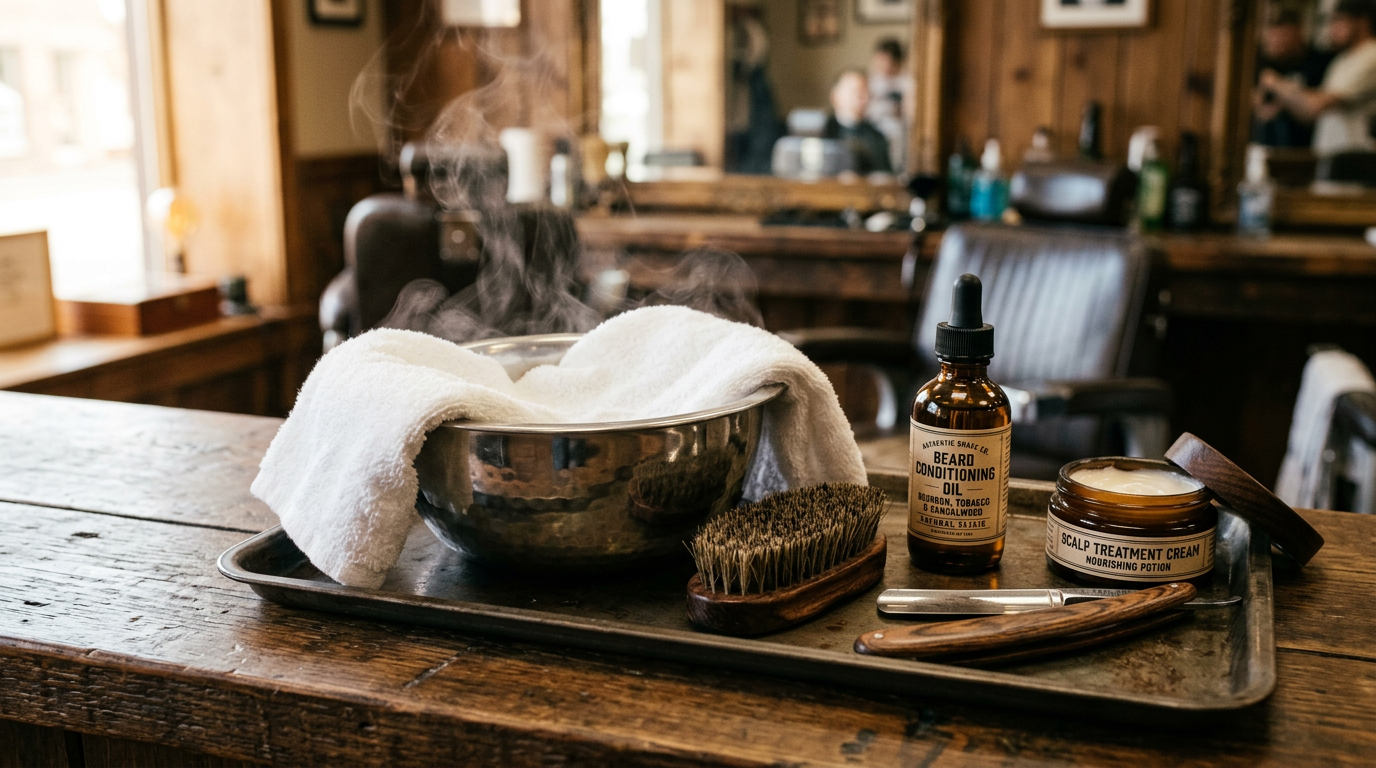
Here's what happens: a barber soaks a towel in water heated to 110-120°F, wrings it out, and drapes it over your face for 2-3 minutes. Sometimes they'll apply pre-shave oil first. The heat does three things simultaneously: it softens beard hair (making it 30-40% easier to cut), opens pores (allowing closer blade contact with the hair shaft), and hydrates the outer skin layer (reducing friction during the shave).
Without this step, a straight razor shave is just dragging a blade across dry, resistant hair. With it, the razor glides. The difference isn't subtle — it's the difference between needing three passes to get smooth and achieving it in one.
The science of heat, pores, and pre-shave prep
Your facial hair is dead keratin, but it's not static. When exposed to heat and moisture, the protein structure temporarily softens. Think of it like cooking pasta — dried spaghetti is brittle and hard to cut; cooked spaghetti offers no resistance. Beard hair behaves similarly (though the analogy breaks down when you consider you're not boiling your face).
Pores don't actually "open" — that's anatomically inaccurate — but heat does relax the follicle opening and soften the sebum (oil) plug that can make hair extraction harder. For men with coarse, curly facial hair, this matters more than for guys with fine, straight growth. If you've ever had ingrown hairs or razor bumps, a proper hot towel treatment before shaving reduces that risk by ensuring the blade cuts the hair cleanly rather than tugging it.
The typical barbershop hot towel treatment costs $5-15 as an add-on, or it's included in a straight razor shave service. If you're booking a shave, this isn't optional — it's foundational. If you're just getting a haircut, skip it unless you're also getting a beard trim with blade work.
When you need it:
- Before any straight razor work (shave or beard edge cleanup)
- If you have coarse, wiry facial hair that resists trimming
- If you're prone to razor burn or ingrown hairs
- If your skin is dry or irritated (the steam provides temporary relief)
When you don't:
- If you're only getting clippers or scissors work
- If you have very oily skin and no shaving is involved (the heat can temporarily increase oil production)
Beard Conditioning: Not a Luxury, a Maintenance Tool
Most men treat beard conditioning like an optional spa treatment. It's not. It's the difference between a beard that feels like steel wool and one that doesn't make your partner avoid kissing you.
Beard hair is structurally different from scalp hair. It's coarser, grows in multiple directions, and lacks the natural oil distribution that scalp hair receives from regular combing and pillow contact. Left untreated, beard hair becomes brittle, splits at the ends, and develops a texture that's uncomfortable to touch.
A barbershop beard conditioning treatment involves applying a leave-in conditioner or beard oil, working it through the hair with a comb or brush, and sometimes steaming it to enhance absorption. The active ingredients — typically argan oil, jojoba oil, or shea butter — coat the hair shaft, fill in microscopic gaps in the cuticle layer, and add flexibility to the protein structure.
What conditioning does to coarse beard hair over time
One treatment won't transform your beard. But consistent conditioning (whether at a barbershop monthly or at home daily) changes the hair's physical properties:
- Reduced breakage: Conditioned hair bends rather than snaps when stressed. This matters if you comb your beard or if it rubs against shirt collars.
- Improved manageability: The cuticle layer lies flatter, so hair doesn't tangle as easily and holds shape better.
- Less itch: Dry beard hair irritates the skin underneath. Conditioning reduces that friction.
- Slower split ends: The protective coating delays the splitting process that happens naturally at hair tips.
The barbershop version differs from at-home conditioning in two ways: barbers use professional-grade products with higher concentrations of active ingredients, and they apply heat or steam to drive the conditioner deeper into the hair shaft. You can replicate some of this at home, but not the product quality or the technique.
Expect to pay $10-20 for a standalone beard conditioning service, or $5-10 as an add-on to a beard trim. If your beard is longer than an inch, this should be part of every barbershop visit. If you keep it short (under half an inch), you can skip it and handle maintenance at home with a basic beard oil.
My take: If you've ever wondered why your beard looks better for a week after a barbershop visit and then reverts to feeling scratchy, it's because the conditioning wore off and you didn't maintain it. Ask your barber what product they used and buy it. The $20 bottle will last three months and eliminate the need for frequent conditioning add-ons.
The Scalp Massage: Why It's More Than Relaxation
A scalp massage feels good. That's not why it's on the menu.
Barbers include scalp massage as part of a haircut for three functional reasons: it distributes product evenly (important after applying styling cream or pomade), it increases blood flow to hair follicles (which can improve hair health over time), and it releases tension in the scalp muscles (which affects how hair lays and can reduce headaches caused by tight fades or prolonged hat wear).
The technique matters. A proper barbershop scalp massage uses firm, circular motions with the fingertips — not the nails — focusing on the temporal muscles (sides of the head), the occipital region (back of the skull), and the frontalis (forehead area). Light, superficial rubbing does nothing. Deep, sustained pressure for 3-5 minutes produces measurable effects.
Circulation, product distribution, and stress relief
Your scalp has a dense network of blood vessels, but poor circulation is common — especially if you wear hats frequently, have a tight haircut, or experience stress-related muscle tension. Reduced blood flow means reduced nutrient delivery to hair follicles, which can contribute to thinning or slower growth.
A scalp massage temporarily increases blood flow by 20-30% for up to an hour afterward. Do this regularly (weekly or bi-weekly), and you're creating a consistently better environment for hair growth. It won't reverse genetic baldness, but it can improve hair quality and scalp health.
Product distribution is practical: if a barber applies pomade or styling cream and doesn't massage it in properly, you end up with uneven coverage — some areas greasy, some areas dry. The massage ensures the product reaches the scalp and coats each hair strand evenly.
Stress relief is real, not placebo. Scalp muscles (particularly the temporalis and occipitalis) hold tension the same way shoulder muscles do. If you've ever had a headache after a fresh skin fade or taper cut, it's because the barber pulled your skin taut repeatedly during clipper work. A post-cut scalp massage releases that tension.
What it typically costs: $5-10 as an add-on, or included in premium haircut packages ($45+). Some barbershops include a brief scalp massage in every haircut; others charge separately for an extended version.
When it's worth it:
- If you wear hats daily (caps, beanies, helmets)
- If you have a tight fade or taper that requires frequent touch-ups
- If you experience scalp dryness or flaking
- If you're using styling products and want even application
- If you get tension headaches
When to skip it:
- If you have a sensitive scalp or skin conditions like psoriasis (pressure can aggravate it)
- If you're in a rush — a proper scalp massage adds 5-7 minutes to the appointment
How to Build a Service Combination That Makes Sense for Your Hair Type
Not every service applies to every man. Here's how to construct a barbershop appointment based on what you're actually working with:
If you have thick, coarse hair and a full beard:
- Haircut (obvious)
- Beard trim with edge cleanup
- Hot towel treatment (before any blade work on the beard)
- Beard conditioning (non-negotiable for coarse growth)
- Scalp massage (helps with product distribution if you use pomade or wax)
Total add-on cost: $20-35 beyond the base haircut. This is the "full menu" experience and makes sense if you visit the barbershop every 3-4 weeks.
If you have fine hair, no beard, and a simple cut:
- Haircut
- Scalp massage (optional, mainly for relaxation)
Skip the hot towel and beard services. You don't need them. If the barber suggests them, they're upselling.
If you have a short beard (under 1 inch) and normal hair:
- Haircut
- Beard trim
- Hot towel treatment (if the trim involves blade work on the cheek or neck lines)
Skip the beard conditioning unless your beard feels wiry. At this length, at-home beard oil is sufficient.
If you're getting a straight razor shave (face or head):
- Hot towel treatment (mandatory — the hot towel treatment prepares skin for a straight razor shave)
- Scalp massage if it's a head shave (helps with product absorption and reduces irritation)
Don't skip the hot towel. That's not an upsell — it's the difference between a smooth shave and a painful one.
If you're dealing with dry scalp, dandruff, or irritation:
- Haircut
- Scalp massage with a treatment oil (ask if they offer tea tree or eucalyptus-based products)
- Skip beard services unless needed
The massage improves circulation and helps anti-dandruff products penetrate better.
What These Add-Ons Typically Cost — and When They're Worth It
Pricing varies by region and shop type, but here's the national average for barbershop add-on services in 2025:
| Service | Standalone Cost | Add-On Cost | Time Added |
|---|---|---|---|
| Hot towel treatment | $10-15 | $5-10 | 3-5 min |
| Beard conditioning | $15-20 | $8-12 | 5-7 min |
| Scalp massage | $10-15 | $5-10 | 5-8 min |
| Straight razor neck cleanup | $8-12 | $5-8 | 3-5 min |
| Full straight razor shave | $35-50 | N/A | 25-35 min |
A base men's haircut ranges from $25-60 depending on location and shop quality. Add-ons can increase the total by 30-70%. The question isn't whether they cost more — it's whether the cost matches the value.
When add-ons are worth it:
- You visit the barbershop infrequently (every 6-8 weeks or longer). Spending an extra $20 once every two months is negligible.
- You have specific hair or skin issues that the service addresses (coarse beard, dry scalp, razor burn).
- You can't or won't maintain your hair/beard properly at home. If you're not using beard oil or scalp treatments between visits, the barbershop service becomes maintenance, not luxury.
- The service is bundled into a package. Many shops offer "full-service" appointments for $60-75 that include everything. That's better value than adding services individually.
When they're not worth it:
- You visit the barbershop weekly or bi-weekly. Frequent visits mean you can skip add-ons most of the time and only include them monthly.
- You maintain your beard and hair well at home. If you're already using quality products and tools, the barbershop version offers diminishing returns.
- The shop charges premium prices but uses generic products. Ask what brand they use. If it's the same $8 beard oil you can buy at the drugstore, you're overpaying.
How to Find a Shop Near You That Offers the Full Menu
Not every barbershop offers the full range of services. Chain shops and budget spots typically stick to haircuts and basic beard trims. Traditional barbershops and premium men's grooming spots are more likely to offer hot towel treatments, beard conditioning, and scalp massage.
Here's how to identify which shops near you offer what you're looking for:
Check the online menu before booking. Most barbershops list services and pricing on their website or booking platform. If you only see "haircut" and "beard trim," they probably don't offer add-ons. Look for phrases like "full-service," "hot towel shave," "beard treatment," or "scalp therapy."
Read reviews for service mentions. Customers who receive hot towel treatments or scalp massages mention them in reviews. Search for keywords like "hot towel," "relaxing," "conditioning," or "massage" in Google or Yelp reviews. If no one mentions these services, the shop likely doesn't offer them.
Look at pricing tiers. Shops that offer $25 haircuts rarely provide add-on services. Shops with haircuts starting at $40+ are more likely to have a full menu. This isn't snobbery — it's economics. Add-on services require time, training, and product investment that budget shops can't support.
Ask when you call or book online. If the shop's website is unclear, ask directly: "Do you offer hot towel treatments and beard conditioning?" A good shop will explain what's included in each service tier.
Use a curated booking platform. Some platforms vet barbershops and only list those meeting quality standards. If you book a full-service barbershop appointment near your address, you're more likely to find shops that offer the complete menu rather than just basic cuts.
My take: The worst scenario is showing up expecting a full-service experience and discovering the shop only does basic cuts. Always confirm the service list before your first visit. If you're trying a new barbershop, check out how to avoid a bad cut at an unfamiliar shop — the same principles apply to service selection.
One more thing: if you find a barbershop that does offer the full menu, ask about package deals. Many shops bundle haircut + beard trim + hot towel + conditioning for $60-70, which is cheaper than adding services individually. And if you're happy with the service, factor that into how much you tip — full-service appointments involve more skill and time than a standard cut.