The Two Places Every DIY Beard Trim Goes Wrong
You spent twenty minutes in front of the bathroom mirror with your trimmer. The length looks good. The bulk is gone. Then you step outside in natural light and see it: a neckline that curves upward on one side, a cheek line that's somehow both too high and uneven, and an overall shape that looks... off.
The problem isn't your trimmer or your technique with the guard. It's geometry.
The neckline problem and why your bathroom mirror lies to you
Your bathroom mirror shows you a straight-on view of your face. Your neckline sits below your jawline, angling back toward your throat. To see it properly, you need to tilt your head back — which changes the angle of your hand, your trimmer, and the line you're trying to cut.
Most men set their neckline too high because they're guessing where their natural jaw-to-neck transition sits. They can't see it clearly, so they err on the side of caution and cut above it. The result: a beard that looks fine from the front but creates a "chinstrap" effect in profile, with too much neck showing and the beard appearing to sit on top of the face rather than frame it.
The cheek line has the opposite problem. You can see it, but you're working with an unsteady hand and a trimmer that removes hair in straight passes. The natural cheek line isn't straight — it follows the contour of your cheekbone and tapers slightly as it approaches your sideburn. When you try to "clean it up" with a trimmer, you end up with a geometric line that looks carved rather than shaped.
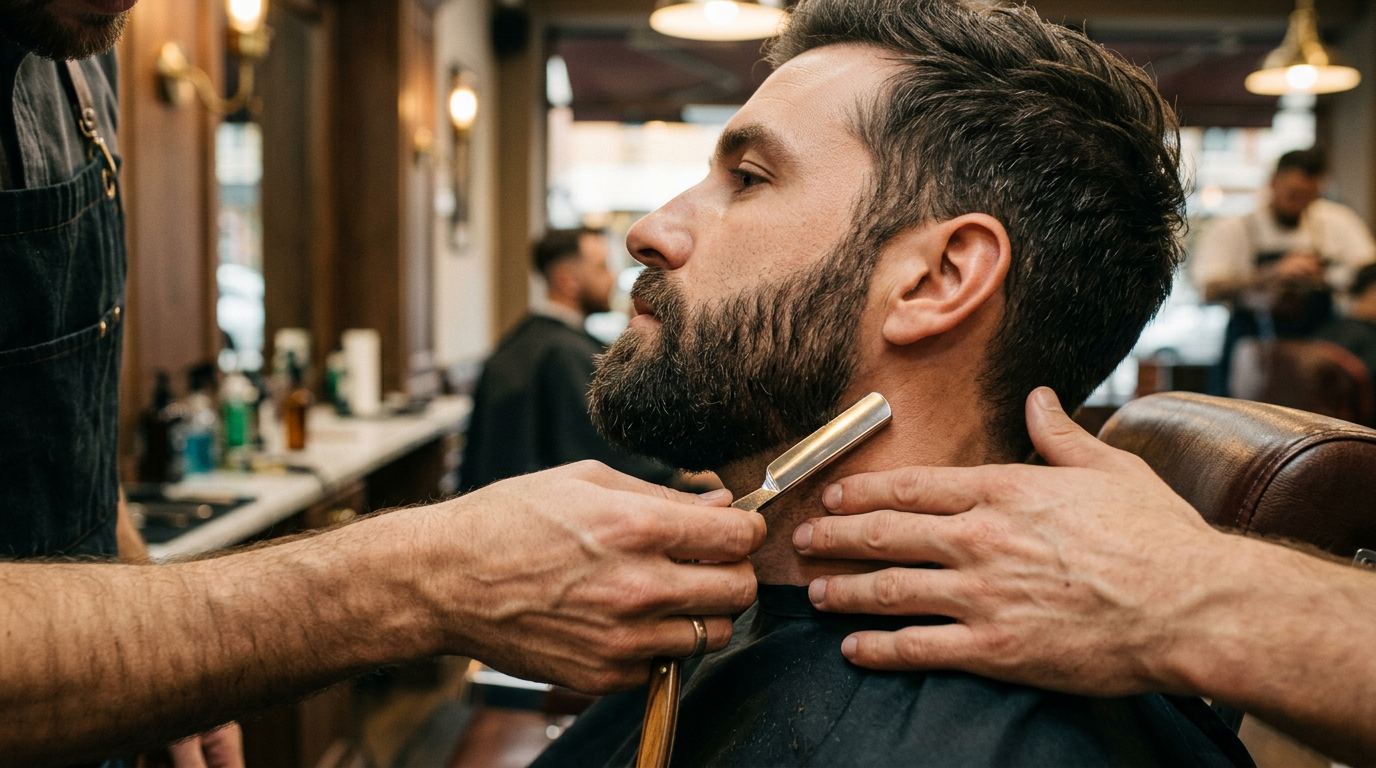
A barber works from the side and uses their non-cutting hand to pull your skin taut. They can see the line from the angle that matters — the one other people see when they look at you. And they're using a straight razor, not a trimmer guard, which means they can follow the natural contour instead of forcing a straight edge.
What a Barber Actually Does When They Trim Your Beard
The professional beard trim starts before any cutting happens. A barber assesses your beard's density, growth pattern, and the shape of your face. They're looking at where your beard naturally wants to grow and where it needs to be controlled.
Here's what happens in the chair:
Hot towel prep — A steamed towel wrapped around your beard for 2-3 minutes. This isn't spa theater. It softens coarse beard hair (which is significantly thicker than scalp hair), opens the follicles, and makes the hair stand up slightly from the skin. When hair is softened, it cuts cleaner. When it's standing up, the barber can see the actual length and shape, not the compressed version you see when your beard is dry and lying flat.
Scissor work over comb — The barber combs your beard outward and cuts with shears, removing bulk while maintaining the natural texture. This is different from running a guard over your face. A guard cuts everything to the same length. Scissors allow the barber to taper the length — shorter near the edges, longer in the center — which creates depth and prevents the "hedge" look.
Straight razor on the lines — This is where the transformation happens. The barber uses a straight razor to define the neckline and cheek line with precision you can't achieve with a trimmer. The razor removes hair at skin level, creating a clean edge that lasts longer than a trimmed line (which leaves stubble). More importantly, the barber is working from an angle where they can see the line in relation to your whole face, not just the isolated patch of skin you're staring at in the mirror.
The neckline gets set about two fingers' width above your Adam's apple, following the natural curve of your jaw. The cheek line gets refined to follow your cheekbone, not carved into a straight edge. Both lines are checked from multiple angles before the barber considers them finished.
Beard oil or balm application — Not optional. After cutting, your beard is dry and the ends are freshly exposed. The barber works a small amount of oil through the beard to coat the hair shaft and prevent the wiry, stiff texture that makes your beard look unkempt by the next day.
This process takes 15-20 minutes. It's not faster than doing it yourself. It's better because the barber has the angle, the tools, and the muscle memory from doing this 6-8 times a day.
If you're already going in for a fade or taper cut, adding a beard trim to the same appointment makes sense — the barber can balance the proportions between your haircut and beard length, which most men don't think about until they see the finished result.
Beard Conditioning: The Step Most Men Skip
You condition the hair on your head. Your beard is hair. The logic writes itself, but most men still don't do it.
Beard hair is structurally different from scalp hair. It's coarser, grows in tighter curls (even on men with straight head hair), and sits against skin that produces more oil. That combination makes beard hair prone to dryness, split ends, and a wiry texture that resists styling.
What it does to coarse hair and why it matters for the next trim
Beard conditioning does three things:
Softens the hair shaft — Conditioner penetrates the outer layer of the hair (the cuticle) and deposits moisture and proteins that make the hair more pliable. Softer hair is easier to trim evenly because it doesn't push back against the blade.
Reduces split ends — Dry beard hair splits at the tip, creating a frayed appearance that makes your beard look messy even when the shape is good. Conditioning seals the cuticle and prevents splitting, which means your beard looks cleaner for longer between trims.
Makes the next trim easier — When your beard is conditioned regularly, the hair grows in a more consistent texture. The barber isn't fighting against wiry patches or areas where the hair has dried out and changed direction. The trim goes faster and the result is more even.
You don't need a separate beard conditioner. A regular hair conditioner works. Apply it in the shower after shampooing, leave it for 60 seconds, rinse thoroughly. Three times a week is enough for most men. Daily if your beard is particularly coarse or if you live in a dry climate.
The difference shows up about two weeks after you start. Your beard stops feeling like steel wool and starts holding the shape you trim it into.
How Often Should You Get a Professional Beard Trim?
Every 3-4 weeks is the maintenance interval that keeps a beard looking intentional rather than accidental.
Beard hair grows about half an inch per month — faster than scalp hair. After three weeks, your neckline has crept upward, your cheek line has blurred, and the overall shape has lost definition. You're not back to square one, but you're past the point where the beard looks maintained.
Some men stretch it to 6 weeks. The beard still looks fine to them because they see it every day and don't notice the gradual loss of shape. But the difference between a 3-week beard trim and a 6-week beard trim is visible to everyone else. It's the difference between "this guy takes care of his appearance" and "this guy has a beard."
If you're growing your beard out, the interval changes. During the first 2-3 months of growth, you still want monthly trims to shape the beard and remove split ends, but the barber isn't taking off length — they're sculpting the shape as it grows. After three months, you can stretch to 5-6 weeks between trims because the beard has enough length that weekly growth doesn't drastically change the proportions.
The cost argument: a professional beard trim runs $15-30 depending on your city. Over a year, that's $180-360 for monthly maintenance. A bad DIY trim that you have to fix by cutting the whole beard shorter costs you 4-6 weeks of growth. Most men would rather pay the $25 than lose a month of progress.
What to Ask For When You Book a Beard Trim
Most men walk into a barbershop and say "just clean it up." That's not enough information.
Be specific:
"Take off [X amount] of length, keep the shape" — If you like your current length, tell the barber exactly how much to remove. Half an inch, a quarter inch, or just the split ends. Don't assume they'll guess correctly.
"Lower/higher cheek line" — If your cheek line is currently too high (making your beard look thin) or too low (making it look unkempt), say so. The barber will adjust it gradually over 2-3 trims to avoid a dramatic change.
"Natural neckline, not carved" — Some barbers default to a very defined, geometric neckline because that's what looks clean in the chair. If you want a more natural line that doesn't look "barbered," specify that upfront.
"Even out the sides" — Most men's beards grow unevenly — one side thicker or longer than the other. The barber can balance this by taking slightly more off the fuller side, but only if you mention it.
If you're trying a new barber, bring a photo of what you want. Not a celebrity with a completely different face shape — a photo of your beard at its best, or a close approximation. It eliminates guesswork.
And if you're booking through a platform, look for barbers who list beard trims as a separate service with a specific time block (15-20 minutes minimum). If beard trims are lumped into "haircut includes beard trim," you're likely getting a quick cleanup with clippers, not the full process described above. When you book a beard trim with a vetted barber near your address, you're looking for someone who treats beard work as a distinct skill, not an add-on.
For context on how barbershop services are typically structured and priced, check out the full service menu breakdown — it helps you understand what you're actually paying for.
Finding a Barber Near You Who Takes Beard Work Seriously
Not every barber is good at beards. Some specialize in fades and barely touch facial hair. Others do solid beard work but don't advertise it. Here's how to find the right one:
Check the portfolio — Look at the barber's Instagram or shop photos. Are there close-up shots of finished beard trims? Do the necklines look clean and properly placed? If all the photos are haircuts, that's where their focus is.
Read the service menu — A barber who takes beard work seriously will list multiple beard services: beard trim, beard shape-up, straight razor shave, hot towel treatment. If "beard trim" is a single line item with no detail, it's probably a quick clipper pass.
Ask about the process — When you call or message to book, ask: "What's included in your beard trim service?" If the answer is just "we trim it to the length you want," keep looking. If the answer includes hot towel, scissor work, and straight razor detailing, you've found someone who knows what they're doing.
Look for barbers who do straight razor shaves — The straight razor shave and the beard trim use the same core skill: precision with a blade on facial hair. A barber who offers traditional straight razor shaves (not just the quick "shave" with a trimmer) almost certainly does quality beard work. The straight razor shave is a technique used at professional barbershops that requires steady hands and an understanding of facial contours — the same skills needed for a clean beard line.
Try the barber once before committing — Book a single appointment, not a recurring slot. See how they handle your beard, whether they ask questions before cutting, and whether the result holds up for 3-4 weeks. If it does, you've found your barber. If not, try someone else.
One more thing: when you find a good barber, tip appropriately. A quality beard trim takes skill and time. If you're unsure about tipping standards, here's the actual answer based on service type and quality.
The difference between a DIY beard trim and a professional one isn't subtle. It's the difference between a beard that looks maintained and one that looks like you tried to maintain it. Most men notice the difference within a day of getting a professional trim — the shape holds, the lines stay clean, and the beard actually looks better as it grows in rather than progressively worse.
That's not something you can replicate with a bathroom mirror and a trimmer. It's a mirror angle you don't have, a straight edge you're not using, and a set of hands that have done this a few thousand times.