The $25 Haircut Question Everyone Googles (Here's the Number)
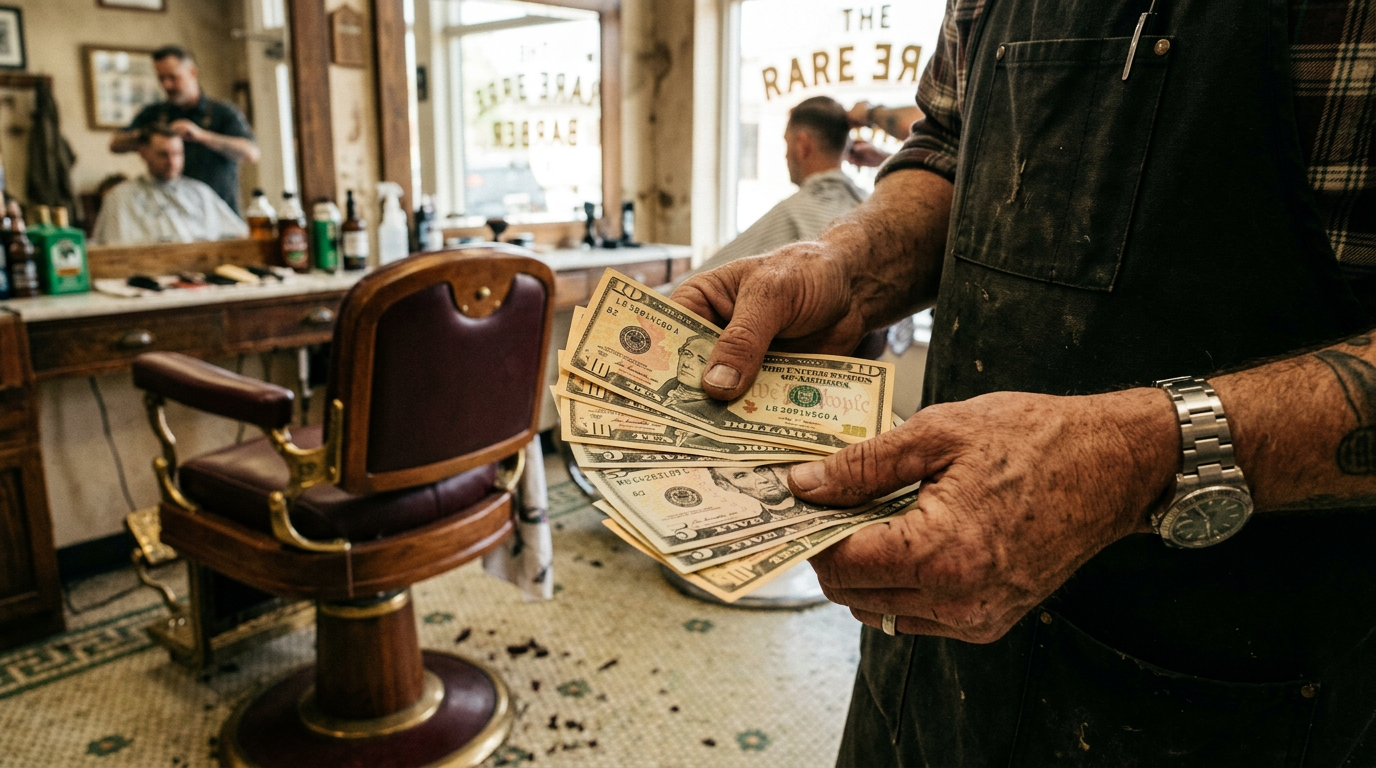
For a $25 haircut, tip $5. Not $3.75. Not "whatever you have in your wallet." Five dollars. That's 20%, and if you're thinking "that seems high," you've stumbled into the exact disconnect this article exists to address.
The internet is full of tipping calculators and polite ranges ("15-20% is customary"), but nobody wants to say what barbers actually think when you hand them three crumpled singles after a half-hour cut. They smile, say thanks, and mentally move you down the priority list. Not out of spite — out of economics.
Most men undertip their barber. Not because they're cheap, but because they don't understand the math on the other side of the chair. A barber doesn't pocket your $25. After booth rent, product costs, and taxes, they're keeping maybe $12-15 of that base price. Your tip isn't extra. It's the difference between whether they can pay rent this month.
This isn't about guilt. It's about understanding what you're actually paying for — and why the guys who tip well never wait three weeks for an appointment.
Why 15% Is the Minimum, Not the Standard
Fifteen percent is what you tip when service was fine but forgettable. It's the baseline. If your barber remembered how you take your fade, asked about your job, and spent 30 minutes making sure the line-up was sharp enough to photograph — 15% is an insult.
The standard should be 20%. Here's why that number isn't arbitrary.
Booth rent, product costs, and what your barber actually keeps
Most barbers don't work on salary. They rent their chair — typically $150-300 per week, depending on the city. That's $600-1200 per month before they've made a single cut. Add liability insurance ($50-100/month), product costs (clippers, guards, scissors, sanitizer, styling products — easily $100-200/month in replacements and supplies), and continuing education (licensing renewals, workshops), and a barber's overhead is $1000-1500 monthly.
Now do the math on a $25 haircut. If they're booked solid at 3 cuts per hour, 8 hours a day, 5 days a week, that's 120 cuts per week. Sounds great until you subtract:
- Booth rent: $250/week (mid-range)
- Product/tool costs: $75/week
- Taxes (self-employed): roughly 25-30% of gross
A barber charging $25 per cut and doing 120 cuts per week grosses $3000. After overhead and taxes, they're taking home maybe $1600-1800. That's $6400-7200 per month before health insurance, retirement, or any other benefit a W-2 employee gets automatically.
Your tip is the margin. It's not bonus money. It's the difference between a decent living and paycheck-to-paycheck stress. When you tip 20% on a $25 cut, that $5 goes directly to the barber — no split, no rent deduction. It's pure income. When you tip $3, you've just told them their time is worth less than a coffee.
Barber tip etiquette isn't about following rules. It's about acknowledging that the person holding sharp objects near your head is running a small business with thin margins. Tipping well isn't generosity. It's fair compensation for skilled labor.
When to Tip More — and When 20% Isn't Enough
Twenty percent is the floor for a standard cut during normal hours. But some situations call for more.
Holiday season, squeeze-in appointments, and fixing someone else's mistake
Holiday season (November-January): Bump to 25-30%. Your barber is working longer hours, dealing with increased demand, and probably hasn't taken a day off in weeks. The week before Christmas? Tip 30% or bring a gift card. This is when they make a significant portion of their annual income.
Squeeze-in appointments: If you texted your barber at 4 PM asking if they can fit you in before a date at 7, and they said yes — tip 30% minimum. They just rearranged their schedule, possibly cut their dinner short, or stayed late. You're not paying for a haircut. You're paying for flexibility.
Fixing another barber's mistake: If you show up with a botched fade from a $10 chain and your barber spends 45 minutes doing corrective work to make it look intentional — tip 40-50%. Fixing bad cuts is harder than starting fresh. It requires creativity, precision, and the patience to not lecture you about going to SuperCuts.
First haircut at a new shop: Tip 25%. You're making a first impression too. Barbers talk. If you're generous on the first visit, word spreads. You become "the guy who tips well," which means better appointment times, more attention to detail, and honest advice when you ask if that style will work with your hairline.
Kids' haircuts: If your barber just spent 20 minutes convincing your 4-year-old that clippers won't hurt while cutting around a moving target — tip extra. Kids' haircuts at a barbershop require a completely different skill set than adult cuts. Patience isn't included in the base price.
Here's a scenario: You book a last-minute appointment on a Saturday (the busiest day), ask for a skin fade with a hard part (30-40 minutes of detailed work), and your barber nails it so well that three people ask where you got it done. Twenty percent isn't enough. That's 30% territory.
Cash vs. Card: Does It Matter to Your Barber?
Yes. Cash is better. Not by a little — by a lot.
When you tip on a card, the barber gets it eventually, but:
- Processing fees: The shop's payment processor takes 2-3%. On a $5 tip, that's 10-15 cents. Seems small until you multiply it by 30 cuts per week.
- Delayed payment: Card tips usually come with the next paycheck or payout cycle. Cash tips go home that day.
- Tax reporting: Card tips are automatically reported. Cash tips should be reported, but the barber has more flexibility in how they manage that income. (Not advocating tax evasion — just acknowledging reality.)
- Splitting tips: In some shops, card tips go into a pool that's split among all staff. Cash tips go directly to the person who cut your hair.
If you're tipping 20% on a card, you're fine. But if you have cash, use it. If you don't carry cash regularly, stop by an ATM before your appointment. Your barber will notice. Not because they're counting every dollar — because it shows you thought about it.
One exception: if you're booking through a platform that lets you add a tip when you pay, and you genuinely won't remember to bring cash, use the card option. A guaranteed 20% on a card beats a forgotten 0% cash tip.
The Real Reason Tipping Well Gets You a Better Haircut
This isn't about barbers giving bad cuts to low tippers. It's about priority and attention.
Barbers remember who tips well. Not in a spreadsheet — in their mental triage of whose appointment gets moved when they're running behind, who gets the benefit of the doubt on a risky style request, and who gets a text when a prime Saturday slot opens up.
Here's what good tippers get:
- Better appointment times: When you call asking for a Saturday morning slot, and your barber has one opening, it's going to the person who tipped $10 on a $30 cut last time — not the person who tipped $2.
- More honest feedback: If you ask for a style that won't work with your hair type, a barber is more likely to talk you out of it (and suggest something better) if they know you value their expertise. Low tippers get what they ask for, even if it's a bad idea.
- Extra time: A 30-minute cut can become 40 minutes if your barber knows you'll tip accordingly. They'll spend extra time on the line-up, make sure the blend is perfect, and ask if you want the back of your neck cleaned up with a straight razor.
- Flexibility: Need to reschedule last-minute? Good tippers get more grace. Barbers are human. They're more accommodating to people who've shown they respect their time.
It's not transactional. It's relational. Booking a barber you trust and tipping them well creates a relationship where both sides benefit. You get consistent quality and priority access. They get reliable income and a client who doesn't nickel-and-dime them.
One barber put it this way: "I give everyone a good cut. But the guys who tip well? They get my best cut. There's a difference."
What to Do If You're Unhappy With the Cut
Tip anyway. At least 15%.
If the cut is bad because your barber misunderstood what you wanted, that's a communication issue — not a skill issue. Tip 15-20%, then politely explain what didn't work. A good barber will offer to fix it for free. If you stiff them on the tip, you've burned the bridge before you can fix the problem.
If the cut is bad because your barber was careless or distracted, tip 10-15% and don't book with them again. But still tip something. Here's why: barbers talk to each other. If you walk out without tipping after a bad cut, the story spreads as "difficult client who didn't tip." If you tip modestly and don't return, the story is "didn't click with that client."
When NOT to tip:
- If your barber was outright rude or disrespectful
- If they were visibly intoxicated or impaired
- If they damaged your hair in a way that requires professional correction (chemical burns, severe unevenness, etc.)
Those situations are rare. In 95% of "bad haircut" scenarios, the issue is fixable, and tipping shows you're not holding a grudge over a misunderstanding.
If you're genuinely unhappy, here's the play: Tip 15%, finish the appointment professionally, then message the shop owner or manager privately. Explain what happened. Most shops will offer a free corrective cut with a different barber or a partial refund. You maintain your reputation as a reasonable client, and you get the issue resolved.
Skipping the tip doesn't solve the problem. It just ensures the barber won't be motivated to fix it.
The Uncomfortable Truth About Barber Economics
The average haircut price has barely moved in 20 years. In 2005, a standard men's cut cost $15-20. In 2025, it's $25-35 in most cities. That's a 50-75% increase over two decades. Meanwhile, booth rent has doubled, product costs have tripled, and inflation has made everything else more expensive.
Barbers can make $100,000 a year, but only if they're booked solid, charging premium rates, and getting tipped well on every cut. The average barber makes $35,000-50,000. Your tip is a significant percentage of their take-home income.
When you walk into a barbershop and see prices on the wall, you're not seeing the full cost structure. You're seeing the base price after the shop has already factored in overhead, competition, and what the market will bear. The tip is where you acknowledge the skill, experience, and personal attention that goes into your cut.
If you're wondering what a men's haircut should cost, the answer includes the tip. A $25 haircut isn't $25. It's $30. A $40 cut is $50. Budget accordingly.
The guys who complain about tipping culture are usually the ones who've never worked a service job. The guys who tip well are the ones who understand that skilled labor deserves fair compensation — and that the relationship with a good barber is worth investing in.
If you've been undertipping, fix it on your next visit. Your barber won't say anything, but they'll notice. And six months from now, when you need a last-minute appointment before a wedding, you'll be glad you did.
Ready to find a barber who's transparent about pricing and worth tipping well? Book a barber near you with upfront pricing and no surprises.