Why Barbershop Prices Are All Over the Map — and What That Tells You
You walk into a barbershop in downtown Chicago and they quote you $75 for a fade. Two miles away, a chain charges $22. Same city. Same haircut request. A $53 difference.
Most price guides will tell you "it depends on location" and leave it at that. That's useless. What actually drives the spread isn't just real estate costs — it's whether the shop is pricing for the haircut you're getting or the experience they're selling around it. And here's the problem: most barbershops actively avoid price transparency because it forces them to justify what you're paying for.
This isn't about finding the cheapest cut. It's about calibrating what fair looks like so you can recognize when you're overpaying for mediocre work — or underpaying in a way that will cost you a relationship with a good barber.
The $20 chain haircut and the $80 boutique cut can both be bad value. Let's break down the real numbers.
What a Standard Men's Haircut Costs by City Tier
Here's what you should expect to pay for a standard men's haircut (clipper cut with scissors on top, no specialty fade work) in 2025:
| City Tier | Price Range | What This Buys |
|---|---|---|
| Major metro (NYC, SF, LA, Chicago) | $45–$75 | Licensed barber, 30–45 min appointment, consultation |
| Mid-size city (Austin, Nashville, Denver) | $35–$55 | Experienced barber, 25–35 min, decent shop environment |
| Suburban/smaller market | $25–$40 | Competent cut, 20–30 min, no-frills shop |
| National chains (Sport Clips, Great Clips) | $18–$28 | Whoever's available, 15–20 min, high volume model |
These numbers assume a weekday appointment with a mid-level barber at the shop (not the owner, not the newest hire). Weekend rates run $5–$10 higher at most places.
Major metro vs. mid-size city vs. suburban market
The geographic price difference isn't arbitrary. In a major metro, commercial rent for a 1,200 sq ft shop can run $8,000–$15,000/month. That's $96,000–$180,000 annually before a single pair of clippers gets plugged in. A suburban shop might pay $2,500–$4,000 for comparable space.
But rent alone doesn't explain a $30 price gap. What you're also paying for in major metros:
- Barber competition for talent: In cities with strong barber culture, experienced barbers can command 60–70% commission splits versus the standard 50–55%. The shop has to price accordingly.
- Client expectations: A $65 haircut in Manhattan comes with an assumption that you're not sitting in a waiting room for 30 minutes, that the shop isn't blasting sports radio, that there's a consultation before the cut starts.
- Licensing and insurance costs: Some states require barbers to carry individual liability insurance. In California, annual barber license renewal and continuing education can run $200–$300 per barber. Shops pass this through.
In mid-size cities, you're getting 80% of the quality at 65% of the price — if you pick the right shop. The barber talent pool is smaller but the overhead is dramatically lower.
Suburban markets are where you find the best pure value if you know what you're looking at. A $32 haircut from a barber who's been in the same shop for 15 years is often technically superior to a $60 cut from a 2-year barber in a trendy downtown shop. But you have to find that person, and they're usually booked solid by word-of-mouth.
Price by Cut Type: Fade, Taper, Skin Fade, Classic
Not all haircuts take the same time or skill level. Here's what different cut types should cost — and why.
Taper cut: $35–$55 in most markets. A taper is a gradual blend from longer hair on top to shorter on the sides. It's foundational barber work. If someone's charging $70 for a basic taper with no added services, you're paying for location or brand, not technique.
Regular fade: $40–$65. A fade is a more aggressive blend that goes to skin or near-skin at the bottom. It requires more precision blending and takes 5–10 minutes longer than a taper. What different cut types cost and why comes down to the number of clipper guard passes and blending time.
Skin fade: $50–$75. This is where you see the biggest price jump — and it's justified. A clean skin fade requires:
- Multiple clipper passes with progressively smaller guards (often 6–8 passes)
- Detailer or trimmer work to clean the fade line
- Razor or shaver work to take the bottom to true skin
- Blending skill to avoid the "line" look
A skin fade done right takes 35–50 minutes. If a shop is charging $45 for a skin fade, either they're underpricing to build clientele (fine for you, unsustainable for them) or they're rushing it. You'll see the difference in how the fade looks after 10 days.
Classic scissor cut: $40–$70. All-scissor cuts (no clippers) are less common now but take longer and require a different skill set. Older barbers trained in the '80s and '90s often prefer this approach. If you find a barber who does excellent scissor-over-comb work, the price is usually justified by the time investment.
Why skin fades cost more and should
The skin fade has become the default request at many barbershops, which has created a pricing problem. Shops that built their reputation on $35 standard cuts now face clients expecting skin fades at the same price.
Here's the math from the barber's side: A standard cut takes 25 minutes. A skin fade takes 40 minutes. If a barber is doing 6 cuts a day at $35 each ($210 revenue, $105–$115 to the barber at 50–55% commission), switching all those to skin fades means they can only do 4 cuts in the same time window. To maintain the same income, the price has to go to $52+.
Some shops handle this with a two-tier menu: standard cut vs. fade cut. Others just raise prices across the board and lose the clients who want simple tapers. A few try to do skin fades at standard-cut prices and compensate by rushing the work.
You can spot a rushed skin fade:
- Visible "steps" in the blend instead of a smooth gradient
- The fade line is too high (starts above the temple instead of at the natural hairline curve)
- The back doesn't match the sides in terms of fade height
- It looks great day 1–3, then falls apart by day 7 because the blend wasn't tight
If you're paying $45 for a skin fade in a major city, you're probably getting rushed work. If you're paying $75 for a basic taper with no fade, you're overpaying for ambiance.
Add-Ons: What Beard Trims, Hot Towels, and Conditioning Actually Add to the Bill
Most barbershops offer add-on services. Here's what they should cost and what you're actually getting:
Beard trim: $15–$25 as an add-on, $25–$40 standalone. This should include:
- Clipper work to even out length
- Scissors to shape the outline
- Trimmer or razor to clean the cheek line and neck line
- 10–15 minutes of work
If they're just running clippers over your beard with one guard and calling it done, that's a $10 service being sold for $20. A proper beard trim involves multiple guard lengths to create shape. Why your beard looks worse after you trim it yourself often comes down to not understanding how to create gradient lengths.
Hot towel treatment: $5–$10. This is primarily a comfort add-on, not a technical service. The hot towel opens pores and softens hair before a cut or shave, but it's not doing anything a hot shower wouldn't do. If a shop is charging $15 for a hot towel, they're pricing it as an "experience" element.
Conditioning treatment: $8–$15. Usually a leave-in conditioner or light oil applied after the cut. This has real value if you have dry scalp or coarse hair, minimal value otherwise. Some high-end shops include this automatically.
Straight razor neck cleanup: Usually included in the haircut price, occasionally $5 extra. If they're charging separately for this, it should be a proper straight razor shave technique with hot towel, not just a quick disposable razor pass.
Scalp massage: $10–$20. Feels great, does nothing for your hair. Pure luxury add-on.
Here's a scenario: You go in for a $50 haircut. They suggest adding a beard trim ($20), hot towel ($8), and conditioning treatment ($12). Your $50 cut is now $90. Were those add-ons pushed because you need them or because the shop has a revenue-per-client target?
A good barber will tell you if the add-on makes sense. "Your beard's already pretty clean, I can just line it up as part of the cut" is the kind of honesty that earns long-term clients.
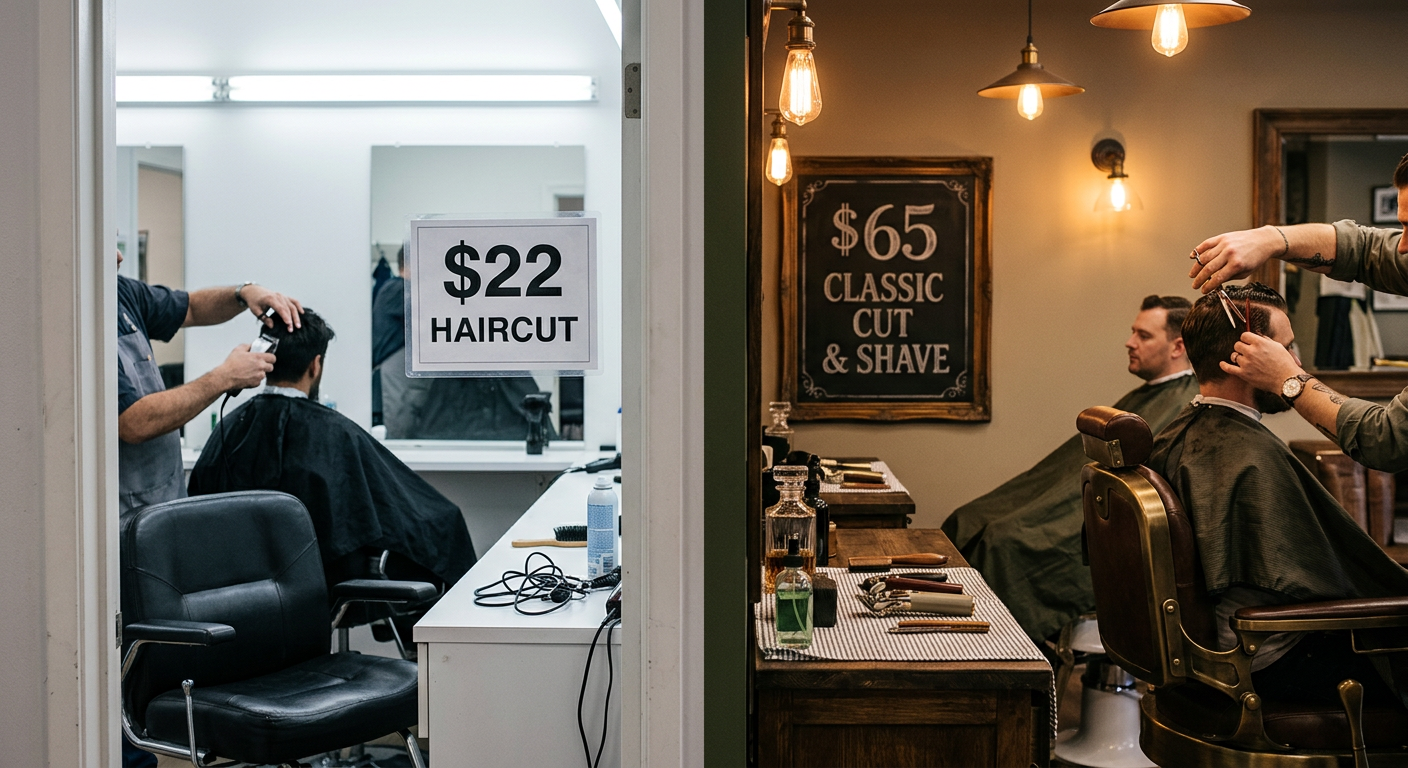
The $20 Haircut vs. the $65 Haircut: What You're Actually Buying
Let's put two haircuts side by side and break down where the money goes.
The $22 chain haircut (Great Clips, Sport Clips, Supercuts):
- 15–20 minute appointment
- Stylist (not barber) with 6 months to 3 years experience
- High volume model: stylist does 20–30 cuts per day
- No consultation — you describe what you want, they start cutting
- Clippers and scissors, usually a decent technical execution of what you asked for
- Walk-in or same-day booking
- Inconsistent results depending on who's working that day
What you're NOT getting:
- Relationship with the person cutting your hair
- Adjustments based on your hair growth pattern or face shape
- Precision fade work (they'll do a fade, but it won't be tight)
- Any service recovery if it goes wrong — you're back in the rotation with whoever's available
The $65 barbershop haircut (independent shop, experienced barber):
- 35–45 minute appointment
- Licensed barber with 3–10+ years experience
- 8–12 cuts per day (lower volume, more time per client)
- Consultation: barber looks at your hair, asks about your routine, makes suggestions
- Precision clipper work, tight fades, attention to detail on the lineup
- Consistent barber — you're booking with the same person each time
- Relationship over time: barber learns your hair, adjusts technique as your preferences evolve
What you're paying extra for:
- Time: The barber isn't rushing to the next client
- Consistency: Same person, same technique, every visit
- Skill ceiling: An experienced barber can do things with a fade that a 1-year stylist can't
- Service recovery: If something's not right, they fix it — and they care about fixing it because you're a repeat client, not a transaction
Here's the nuance: The $65 cut isn't always better if you don't need what it offers. If you get a simple #4 guard all over every 3 weeks, the chain cut is fine. You're not utilizing the skill you're paying for at the independent shop.
But if you want a skin fade that looks good for 2+ weeks, if you have a cowlick that needs to be cut with the grain, if you want a barber who remembers that you don't like the lineup too sharp on the corners — that's when the $65 cut becomes worth it.
The worst value is the $65 cut from a mediocre barber at a trendy shop. You're paying for the shop's Instagram aesthetic and exposed brick walls, not the quality of the work.
How to Know If You're Overpaying
You're overpaying if:
The shop's pricing is vague or inconsistent. If you call and ask how much a fade costs and they say "it depends" without explaining what it depends on, that's a red flag. Transparent shops list prices by cut type.
Your haircut looks great for 3 days, then falls apart. A proper fade should look good for 10–14 days. If it's looking rough by day 5, the blend wasn't tight. You paid for precision work and got speed work.
You're paying $60+ but the barber is double-booked or rushing. High prices should come with adequate time. If your barber is glancing at their phone or obviously trying to move you along at the 25-minute mark, you're subsidizing their overbooking.
The "consultation" is just them repeating your request back to you. A real consultation involves the barber looking at your hair growth pattern, face shape, and lifestyle ("Do you style it every day or just wash and go?") and making suggestions. If they just say "So you want a mid fade, #3 on top?" and start cutting, that's order-taking, not barbering.
Add-ons are pushed on every visit. A barber who suggests a beard trim or conditioning treatment occasionally based on what they see is being helpful. A barber who suggests the same add-ons every single visit regardless of whether you need them is hitting a sales quota.
The shop is beautiful but the work is average. Some shops invest heavily in aesthetics — leather chairs, Edison bulbs, craft beer in the waiting area — and charge accordingly. If the haircut itself is technically average, you're paying a premium for ambiance. That's fine if you value the experience, but call it what it is.
You can't get the same barber twice. Consistency is part of what you pay for at a higher price point. If the shop can't get you in with the same barber within a reasonable timeframe (2–3 weeks), their pricing should reflect that they're selling individual cuts, not barber relationships.
You're getting fair value if:
- The price matches the time and skill level you're receiving
- The haircut looks good for 10–14 days before needing a touch-up
- The barber makes adjustments based on your hair, not just your request
- You can book the same barber consistently
- The shop is transparent about what costs what and why
You might actually be underpaying if:
- You found a veteran barber in a low-cost market who's charging $30–$35 for work that would cost $60 in a major city
- You're getting 45 minutes of attention and precision work for $40–$45
That last scenario is the best value in barbering, but it's also the most fragile. Those barbers eventually raise prices, move to higher-end shops, or get booked so solid you can't get in. When you find one, become a regular immediately.
How to Find a Barber at the Right Price Point Near You
Pricing research before you commit:
Check the shop's website or Instagram for a service menu. If prices aren't listed, call and ask specifically: "What do you charge for a skin fade?" If they won't quote a price over the phone, that's a yellow flag.
Look at the booking system. Shops using Booksy or similar platforms usually have barber-specific pricing. You can see if the senior barbers charge more than junior barbers. That's a good sign — it means the shop is pricing for skill level, not just applying a flat rate.
Read reviews for price mentions. Google and Yelp reviews often include what people paid. If you see consistent mentions of "$55 for a fade" and one review saying "$75 for the same cut," that's either inconsistent pricing or upselling.
Ask about tipping expectations when you book. Some shops include gratuity, most don't. A $50 cut becomes $60–$65 after tip. Factor that into your price comparison.
Consider the first-visit risk. Your first haircut at a new barbershop is always a gamble. If you're trying a shop at the higher end of your budget, book a weekday appointment (often slightly cheaper) and a cut type that's hard to mess up (standard taper, not a complex skin fade).
When you're comparing shops:
- Don't just compare the base haircut price — compare what's included (beard trim? hot towel? lineup?)
- Look at the barber's experience level, not just the shop's reputation
- Factor in convenience (a $45 cut you can book easily beats a $40 cut that requires 3 weeks advance notice)
- Consider the walk-in vs. appointment tradeoff — walk-in pricing is sometimes lower but you're gambling on wait time
If you want to find a top-rated barber near you with transparent pricing and compare options by cut type, location, and barber experience level, that's a faster way to calibrate what fair looks like in your market than calling 12 shops individually.
The right price point isn't the lowest or the highest — it's the one where what you're paying matches what you're getting, and you can build a consistent relationship with a barber who does good work. That might be $32 in a suburban shop or $68 in a downtown market. But you should know why you're paying what you're paying.